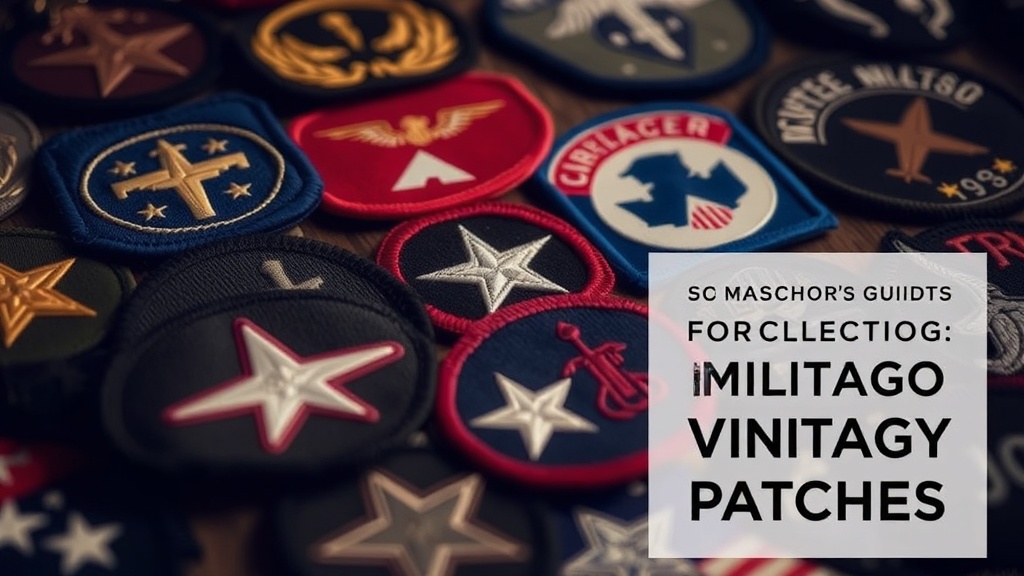
A Beginner's Guide to Collecting Vintage Military Patches

This guide covers everything needed to start collecting vintage military patches — from spotting fakes and understanding unit histories to storing patches properly and building a collection without overspending. Whether drawn to World War II shoulder sleeve insignia or Vietnam-era morale patches, you'll find practical steps here to buy smarter, organize better, and enjoy the hobby for years.
What Makes Vintage Military Patches Worth Collecting?
Vintage military patches are small, affordable pieces of history. Each one represents a specific unit, campaign, or era — and unlike larger militaria (helmets, uniforms, firearms), patches don't take up much space. That said, their value isn't just monetary. Collectors often gravitate toward patches because of the stories they carry. A 101st Airborne Division "Screaming Eagle" patch from D-Day isn't merely cloth and thread. It's a tangible connection to one of the most significant military operations in history.
The market for vintage patches has remained steady — even grown — over the last decade. Beginners can build impressive collections for under a few hundred dollars, while rare variants (like theater-made patches from the China-Burma-India Theater) can fetch thousands at auction. Here's the thing: you don't need deep pockets to get started. Many excellent patches sell for $10 to $50 apiece.
Collecting also opens doors to a tight-knit community. Shows like the Chicago Military Show bring together dealers, historians, and hobbyists who are usually happy to share knowledge. Online forums and Facebook groups dedicated to U.S. military insignia offer daily opportunities to learn, trade, and ask questions.
How Do Beginners Build a Patch Collection Without Getting Overwhelmed?
Start narrow. Pick one branch, one war, or even one division — and resist the urge to buy everything that looks interesting. A focused collection is easier to research, display, and insure. Many successful collectors begin with World War II U.S. Army shoulder sleeve insignia (SSI) because documentation is abundant and patches are relatively common.
Set a monthly budget and stick to it. It's easy to get caught up in auction fever, especially on eBay, where bidding wars can push prices well past retail value. The catch? Patience usually pays off. Most patches circle back around eventually. Keep a want list on your phone — when you spot something at a show or online, cross-check it against your list before pulling the trigger.
Buy reference books early. United States Army Shoulder Patches and Related Insignia by Barry Jason Stein is a standard text you'll see on every serious collector's shelf. For Navy collectors, United States Navy Patches by Michael L. Roberts offers detailed coverage of aviation and ship insignia. These books aren't cheap — expect $40 to $80 each — but they'll save you from expensive mistakes.
Here's a simple framework for choosing your first focus area:
| Category | Difficulty for Beginners | Average Price Range | Best Starting Point |
|---|---|---|---|
| WWII U.S. Army SSI | Easy | $15 – $75 | Common divisions (1st Infantry, 82nd Airborne) |
| Vietnam Theater-Made Patches | Moderate | $25 – $200 | MACV or Special Forces variants |
| U.S. Navy Ship Patches | Moderate | $20 – $150 | Well-known carriers (USS Enterprise, USS Midway) |
| WWI Shoulder Insignia | Hard | $75 – $500+ | Common divisions (26th "Yankee" Division) |
How Can You Tell If a Military Patch Is Authentic?
Learning to spot reproductions and fakes is the single most important skill in this hobby. The good news? Most common patches have been studied extensively, and telltale signs of inauthenticity are well documented. The bad news? Some modern reproductions are remarkably convincing — especially silk-screened copies sold as "vintage style" that later enter the secondary market unmarked.
Start by examining the back. Authentic WWII-era patches typically show age-appropriate backing material — cotton twill, wool felt, or cheesecloth. The stitching should be consistent with period manufacturing methods. Hand-embroidered theater-made patches from Vietnam often have irregular backs with loose threads — that's actually a positive sign, since machine-perfect backing usually indicates mass production.
Study the colors. Many reproductions use dyes that are slightly too bright or too uniform. A genuine 1940s patch has often faded in specific ways — the edges may be lighter than the center, or certain thread colors (especially reds and blues) may have dulled differently than others. Compare your patch against high-resolution photos in reference books or trusted collector sites like the National WWII Museum archives.
Worth noting: "aged artificially" is a huge red flag. Sellers who bury patches in dirt, scorch edges with cigarettes, or stain them with tea are usually hiding something. Real age looks uneven. Patches pulled from uniforms often show wear exactly where they rubbed against straps or web gear — not uniformly across the surface.
When buying online, demand clear photos of the front and back. If a seller refuses or provides only stock images, walk away. Reputable dealers — names like Advance Guard Militaria, Griffin Militaria, and Manion's International Auction House — photograph every angle and describe condition honestly.
Where Should You Buy Vintage Military Patches?
The best purchases often happen in person. Militaria shows, gun shows with militaria vendors, and estate sales give you the chance to handle patches before buying. You can inspect backing, thread quality, and fading with your own eyes — and negotiate face-to-face. The Omaha Military Collectors Show and regional events around the Midwest draw strong dealer attendance every year.
Online marketplaces expand your reach enormously. eBay remains the largest source, but it's a minefield of reproductions mixed with authentic pieces. The key is filtering — search for sellers with thousands of positive feedback scores and return policies. Facebook Marketplace and collector groups can yield deals, though scams are common. Pay with methods that offer buyer protection.
Auction houses are excellent for higher-end pieces. Companies like Heritage Auctions and Soulis Auctions regularly sell military insignia collections from estates. You'll pay a buyer's premium (usually 20% to 25%), but the authenticity guarantee is often worth it for four-figure purchases.
Avoid these common beginner traps:
- "Old stock" or "vintage style" listings — These are almost always reproductions.
- Bulk lots with no photos of individual patches — You'll receive junk 90% of the time.
- Patches attached to "vintage" jackets bought from costume shops — The jacket might look old; the patch is usually new.
- Sellers who claim "my grandfather brought this home" — Maybe true, maybe not. Provenance needs documentation.
What's the Best Way to Store and Display a Patch Collection?
Proper storage protects both the patch and its value. Light, humidity, and improper mounting are the three biggest enemies. Patches should never be stored in direct sunlight — UV rays fade thread colors irreversibly within months. Basements and attics are poor choices because temperature swings and moisture encourage mold and rot.
For unmounted patches, archival-quality polyethylene or polyester pages (like those made by Ultra-PRO) stored in three-ring binders work beautifully. Make sure the pages are PVC-free — PVC emits gases that yellow fabric over time. Slip a sheet of acid-free cardstock behind each patch to prevent impressions showing through.
Displaying patches is where collectors get creative. Shadow boxes with UV-protective glass are the gold standard. You can arrange patches by war, branch, or theater — and include small captions with unit names and dates. For a more casual look, cork boards or linen-backed display boards work well in home offices. Just keep them out of direct sun.
Never glue patches to a backing board. The adhesive damages fibers and destroys resale value. Use stainless steel pins (for temporary display) or conservation-grade mounting corners. Some collectors sew patches onto muslin backings inside frames — an elegant solution, though it takes time.
If the collection grows beyond a few dozen pieces, catalog everything. A simple spreadsheet with columns for description, estimated date, source, price paid, and condition will serve you well. Apps like Collectr and Numista (adapted for militaria) can help, though a Google Sheet works just fine.
How Do You Learn More and Connect With Other Collectors?
The learning curve in military patch collecting is steep but rewarding. Books and online archives provide the foundation, but relationships with other collectors accelerate progress dramatically. Join organizations like the Orders and Medals Society of America (OMSA) or regional militaria clubs. Attend meetings, ask questions, and handle pieces that more experienced collectors bring in.
Social media has transformed the hobby. Instagram accounts run by dedicated collectors showcase rare pieces daily — follow hashtags like #militariacollecting and #shouldersleeveinsignia. YouTube channels such as The Collectors Guild offer detailed patch identification videos that are genuinely useful for visual learners.
Don't rush to become an expert. Every collector — even those with decades of experience — occasionally buys a questionable patch. The goal isn't perfection; it's building a collection that brings satisfaction, preserves history, and maybe — if you're lucky — appreciates in value over time. Start small, research constantly, and enjoy the hunt. That's where the real reward lives.