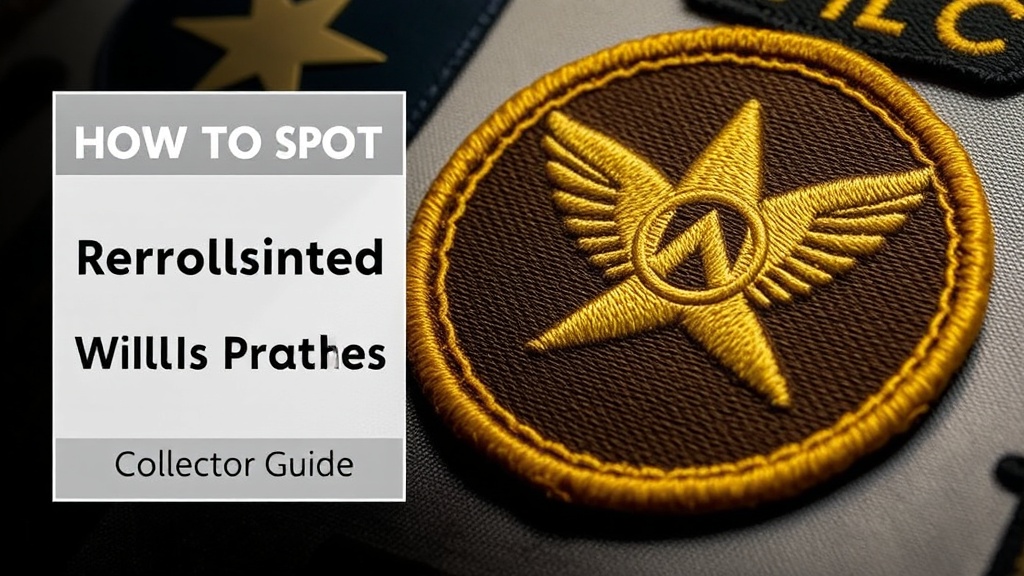
How to Spot Reproduced WWII Military Patches: A Collector's Guide

Quick Tip
Always examine the reverse side of a military patch—authentic WWII patches feature irregular, hand-finished stitching while reproductions typically show machine-perfect, uniform seams.
Authentic WWII military patches represent significant historical and monetary value—genuine examples often command $50 to $300+ depending on rarity and condition. The problem? Reproductions flood the market. Knowing how to distinguish a 1944 shoulder sleeve insignia from a 1990s copy (or a recent Chinese import) protects your wallet and your collection's integrity. This guide covers the construction details, materials, and authentication markers that separate real artifacts from fakes.
What Are the Visual Differences Between Real and Fake WWII Patches?
Authentic WWII patches exhibit specific embroidery characteristics that modern reproductions rarely replicate perfectly. Original pieces typically feature wool felt or twill backing with cotton or wool embroidery threads. Reproductions often use synthetic materials—polyester felt has a telltale stiffness and overly uniform texture.
Here's the thing: look closely at the edges. WWII-era patches were often cut with pinking shears or left with merrowed edges (that overlock stitch you see on modern patches). The catch? Merrowing became standard post-1945. A "WWII" patch with perfect merrowed edges everywhere? Suspicious.
Coloration matters too. Original OD (olive drab) shades from the 1940s have a distinct muted quality—reproductions tend toward brighter, more saturated greens. The National WWII Museum maintains excellent reference galleries for color comparison.
| Feature | Authentic WWII | Common Reproduction |
|---|---|---|
| Backing Material | Wool felt, cotton twill, or rayon | Stiff synthetic felt or modern cotton |
| Thread Type | Cotton or wool (slight sheen variations) | Polyester (consistent, plastic-like shine) |
| Edge Finish | Pinked, raw cut, or partial merrow | Full merrowed edge (modern technique) |
| Embroidery Density | Slightly irregular, hand-guided machine work | Computer-perfect uniformity |
| Rear Appearance | Visible thread knots, occasional paper backing residue | Clean, often with iron-on adhesive |
How Can You Tell If a WWII Patch Has the Right Construction?
Construction methods changed significantly after 1945. Original patches were produced on single-head or multi-head embroidery machines operated by skilled workers—resulting in slight variations between supposedly identical patches. Modern reproductions use computerized embroidery that produces pixel-perfect duplicates.
Flip the patch over. Authentic pieces show the embroidery's reverse side—threads crossing, occasional knots, sometimes paper backing remnants from starching processes. Reproductions often have a clean "iron-on" adhesive layer or dense stabilizer material covering the back entirely.
Worth noting: military patches weren't standardized until the mid-1950s. Variation was normal. Two "identical" 1st Infantry Division patches from 1943 might have slightly different embroidery patterns. If someone offers you ten "rare" patches that look absolutely identical? Walk away.
Stitch Patterns to Examine
- Satin stitch areas — Originals show slight thread angle variations; reproductions maintain perfect parallel alignment
- Jump stitches — The connecting threads between design elements were typically trimmed closely on WWII pieces; modern machines often leave longer jumps
- Fill patterns — Look for irregularities in how solid areas are filled; authentic pieces sometimes have visible direction changes in the stitching
Where Should You Buy Authentic WWII Patches?
Provenance and seller reputation matter more than any single visual test. Established dealers who specialize in militaria—places like International Military Antiques or auction houses with dedicated militaria departments—provide documentation and return policies that private sellers often won't.
That said, eBay and estate sales can yield legitimate finds. The risk? Higher. You'll need to apply every authentication technique. Request detailed photos of front and back. Ask about provenance—where did this come from? A family grouping (patch plus discharge papers, photos, or other items from one veteran) carries more weight than a "rare find" with no history.
Consider joining the Orders and Medals Society of America (OMSA)—members access authentication resources and dealer recommendations that casual collectors don't have. The investment in membership pays for itself if it prevents one bad purchase.
"The best authentication tool is your own educated eye. Handle enough originals, and reproductions start to feel wrong before you can articulate why."
Storage matters too—once you've acquired authentic pieces. Keep patches flat in archival-quality sleeves (Mylar D is the gold standard) away from direct light and humidity. Don't attach them to uniforms with modern safety pins; the steel can rust and stain decades-old fabric. Museum wax or careful mounting preserves both the artifact and its value.