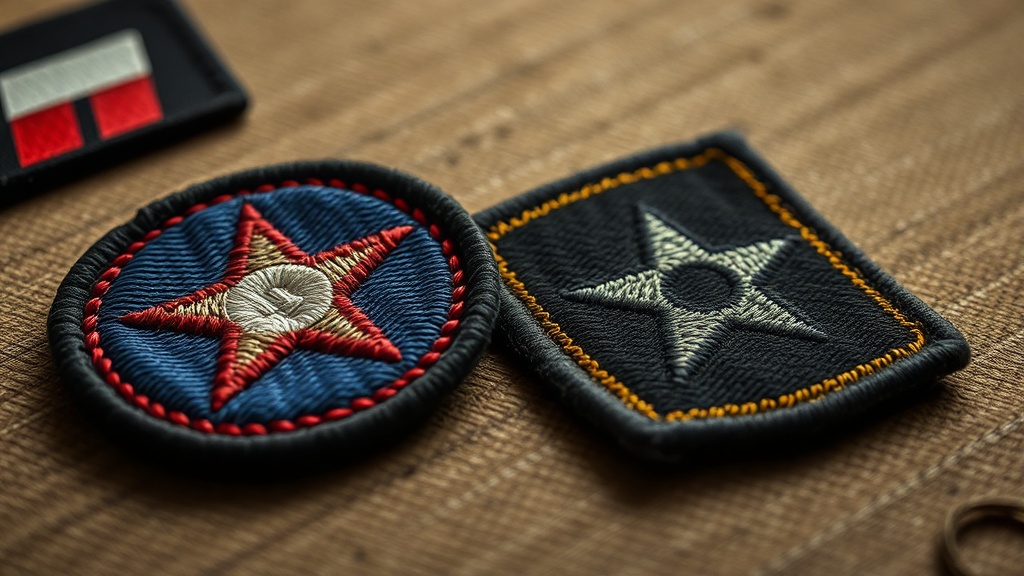
Identifying Thread Types in Vintage Military Patches

A magnifying glass reveals the microscopic difference between a single strand of silk and a twisted synthetic fiber. This guide examines how thread composition determines the age, authenticity, and value of vintage military patches. Understanding these materials helps you distinguish between a genuine WWII-era unit patch and a modern reproduction that uses contemporary machine-made embroidery.
Identifying thread types isn't just a hobbyist's obsession—it's the most reliable way to verify a patch's era. If you see a high-sheen, perfectly uniform polyester thread on a patch supposedly from 1942, you've found a red flag. The material used in the embroidery tells a story of industrial capacity, available resources, and the specific military requirements of the time.
What Are the Common Thread Types in Vintage Patches?
The three most common thread types found in vintage military insignia are silk, cotton, and rayon. Each material has a distinct visual signature and physical behavior that collectors use to date an item.
Silk was the standard for high-end or early-era insignia due to its strength and natural luster. However, it's quite rare in standard field-issue patches because it was expensive and difficult to mass-produce for the front lines. Most "silk" patches you see on the market are actually high-quality rayon or silk-blend. If you're looking at a high-value collector piece, the presence of actual silk fiber is a massive indicator of quality and age.
Cotton thread was the workhorse of the mid-20th century. It has a matte finish and a slightly fuzzy texture under magnification. Unlike modern synthetic threads, cotton doesn't have a "glint" when it catches the light. If a patch is supposed to be a standard-issue WWII infantry patch, you expect to see the dull, organic look of cotton. It’s a subtle detail, but it’s exactly what separates the pros from the amateurs.
Rayon became the industry standard as synthetic manufacturing advanced. It provides a much higher sheen than cotton and is significantly smoother. It's often used in modern reproductions to mimic the look of silk, but it lacks the structural "soul" of older materials. You can often tell rayon from the way it drapes or how the edges of the embroidery look under a jeweler's loupe.
| Material | Visual Texture | Typical Era | Common Use |
|---|---|---|---|
| Silk | High sheen, very smooth | Pre-WWII / Early 20th Century | High-ranking officer insignia |
| Cotton | Matte, slightly fuzzy | WWII to 1950s | Standard issue field patches |
| Rayon | High sheen, uniform | Post-1960s / Modern | Modern reproductions & commercial patches |
| Polyester | Shiny, highly consistent | Late 20th Century to Present | Modern tactical/commercial gear |
How Do You Distinguish Between Cotton and Synthetic Threads?
You can distinguish between cotton and synthetic threads by observing the light reflection and the microscopic surface texture. Cotton absorbs light, creating a duller, more organic appearance, while synthetics reflect light more sharply.
Grab a bright flashlight and shine it at an angle against the patch. A cotton thread will look slightly irregular and "soft." A synthetic thread—like the polyester used in modern embroidery—will look almost too perfect. It has a consistent, plastic-like shine that doesn't quite match the rugged aesthetic of vintage military gear. (Note: Don't use a high-powered laser to check this; a simple LED flashlight is enough.)
If you see a "halo" of tiny, stray fibers around the embroidery, you're likely looking at cotton. Synthetic threads are engineered to be incredibly clean and often lack that organic imperfection. This is a big part of distinguishing between authentic vintage and modern reproductions. A modern machine-made patch often lacks the character of a hand-guided or older industrial embroidery machine.
The Role of Luster and Sheen
Luster is a dead giveaway for age. In the early 20th century, insignia were often made with more natural fibers. As the world moved toward mass production, the "look" of the thread changed. If you're looking at a patch that is supposed to be from the 1940s, but it shines like a brand-new piece of sports apparel, be skeptical. The luster of rayon is much more aggressive and uniform than the subtle sheen of aged cotton.
It's also worth noting the color consistency. Natural dyes and cotton threads tend to age and fade in a way that looks organic. Synthetic dyes are incredibly stable. If the colors are vibrantly "neon" or overly bright, it's a sign of modern polyester or high-sheen rayon. This is why many collectors spend so much time preventing UV damage to their patch displays—the light can actually alter how these materials present over time.
Does Thread Type Affect the Value of a Patch?
Yes, the thread type significantly affects the value because it serves as a primary indicator of authenticity and rarity. A patch made with period-correct silk or high-quality cotton is much more valuable to a serious collector than a modern polyester version.
Collectors aren't just buying a piece of fabric; they're buying a piece of history. A patch with authentic silk-thread embroidery from a specific era is a rarity. It shows the craftsmanship of the time. On the flip side, a patch made with modern, mass-produced synthetic thread is often viewed as a "souvenir" or a "repro" rather than a true collectible. The material is the first line of defense against being fooled by a high-quality fake.
Here is a quick checklist for your next inspection:
- Check the Shine: Is it a dull matte (Cotton/Vintage) or a bright sheen (Rayon/Modern)?
- Examine the Surface: Are there tiny stray fibers (Natural) or is it perfectly smooth (Synthetic)?
- Look at the Color: Is the color slightly muted/aged or is it strikingly bright and consistent?
- Check the Thickness: Are the threads slightly irregular in diameter (Vintage) or perfectly uniform (Modern)?
When you're out at a flea market or browsing an online auction, don't just look at the shape of the patch. Look at the texture of the thread. That's where the truth lies. If you're ever in doubt, ask yourself: "Would a machine in 1943 have been able to produce this specific level of synthetic perfection?" Usually, the answer is a hard no.
The more you study these textures, the more intuitive it becomes. You'll start to recognize the "feel" of a piece just by looking at a high-resolution photo. This is the difference between a casual buyer and a true collector. It's about the details—the tiny, microscopic details that most people skip right over.