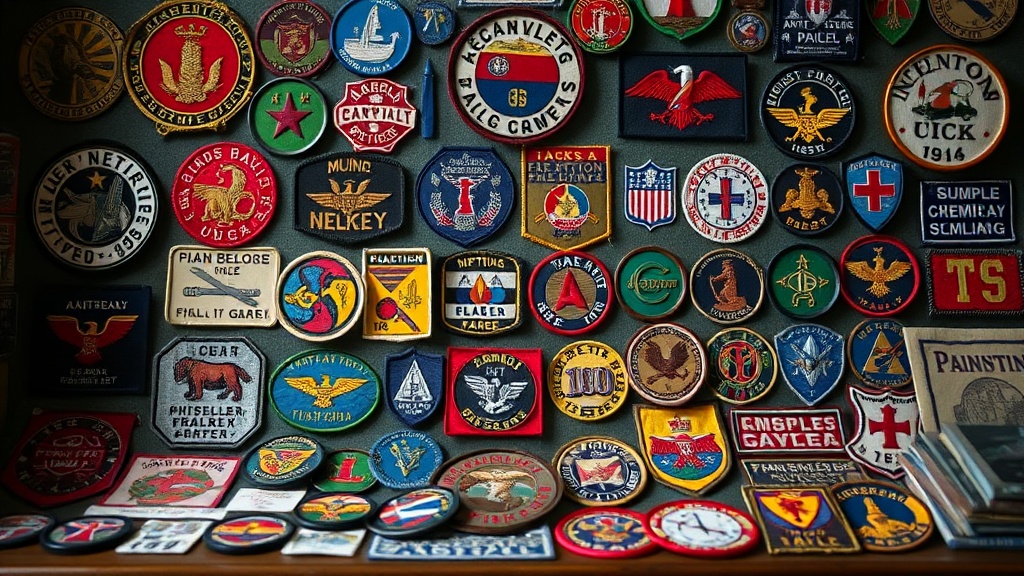
Organizing Your Patch Collection by Era and Branch

Most collectors think a messy pile of patches is just part of the hobby's charm. They're wrong. If you don't organize your collection by era and branch now, you'll end up with a chaotic bin of unidentifiable thread and lost history. This guide breaks down how to categorize your inventory using chronological and organizational systems that make sense for serious collectors.
How Should You Organize a Military Patch Collection?
The most effective way to organize a collection is to separate items by their historical era first, then by their specific military branch. This method prevents you from mixing a 1940s WWII nose art patch with a modern 2020s unit insignia. When you group by era, you create a logical timeline of military evolution. When you group by branch, you create a sense of order within those specific timeframes.
Start by creating distinct zones for your collection. You might use different display cases or specialized binders for different periods. A collector focused on the World War II era needs a completely different storage mindset than someone collecting modern tactical PVC patches. One requires protection from moisture and oxidation, while the other might just need a clear view for a display board.
Here is a basic framework for your initial sorting process:
- The Era Sort: Group items into broad buckets like WWI, WWII, Vietnam, Cold War, and Modern Era.
- The Branch Sort: Within those buckets, divide by service branches (Army, Navy, Air Force, Marines, Coast Guard).
- The Type Sort: Separate embroidered patches from PVC, metal pins, or cloth insignia.
Don't try to do this all in one afternoon. It's a massive undertaking. Grab a coffee, clear a large table, and take it one era at a time.
What are the Best Eras for Organizing Collections?
The best eras to use for organization are the major conflict periods that define military aesthetics: the World Wars, the Vietnam Era, and the Post-Cold War/Modern Era.
The World War Era (1914–1945)
These are often the crown jewels of any collection. You'll see a lot of heavy embroidery and high-quality cotton twill. During this time, many patches were hand-sewn or produced in smaller batches. If you find a patch from this period, treat it with extreme care. It's likely fragile. If you're worried about the longevity of these pieces, check out my guide on preventing UV damage to your patch display.
The Vietnam and Cold War Era (1950s–1980s)
This is a massive middle ground. You'll see the transition from traditional embroidery to more standardized, mass-produced cloth patches. This is also where "subdued" designs become much more common. The aesthetic is much more utilitarian and less "ornate" than the earlier eras.
The Modern/Tactical Era (1990s–Present)
This era is dominated by high-tech materials. You'll encounter a lot of PVC (polyvinyl chloride), laser-cut Cordura, and velcro-backed insignia. The designs are often more subdued or tactical in nature. These are easier to clean and store, but they can sometimes feel less "classic" than the vintage stuff.
It's worth noting that some collectors prefer to organize by "function" rather than "time." For example, keeping all your "morale patches" in one section and all your "official unit insignia" in another. That's a valid way to do it, but it can get messy if you don't have a strict rule for what qualifies as "morale."
Comparison of Era Characteristics
| Era | Primary Materials | Common Design Style | Storage Priority |
|---|---|---|---|
| World War Era | Cotton, Heavy Thread | Ornate, Hand-stitched | High (Moisture/UV) |
| Vietnam/Cold War | Standard Twill, Nylon | Functional, Subdued | Medium |
| Modern/Tactical | PVC, Velcro, Cordura | Tactical, Minimalist | Low (Durability) |
How Do I Identify the Branch of a Vintage Patch?
You can identify the branch by looking at specific heraldic symbols, color schemes, and official insignia patterns found on the patch.
Identifying a branch isn't always a slam dunk. Some patches use generic symbols that could apply to multiple services. However, there are usually "tells." For instance, the US Navy often utilizes maritime symbols like anchors or specific sea creatures, while the Army might lean heavily into infantry or cavalry-related iconography. The Air Force, of course, is heavily tied to aeronautical symbols. If you're looking at a patch and you're totally lost, you might need to consult a reference book or an official source like the official US Army website to verify insignia standards.
A common mistake is assuming a patch's color tells you everything. A green patch doesn't always mean "Army." It depends on the era. A green patch from the 1940s might be a specific unit insignia, whereas a green patch from the 2010s is likely a tactical subdued design. Always look at the symbol first, then the material, then the color.
If you're dealing with a patch that looks like it might be a reproduction, you need to be careful. I've written about distinguishing between authentic vintage and modern reproductions before. Use those techniques here to ensure you aren't mislabeling a modern piece as a vintage one during your sorting process.
Here are the main branches to keep in mind:
- Army: Often uses infantry, artillery, or cavalry symbols.
- Navy: Anchors, ships, and maritime themes.
- Air Force: Wings, stars, and flight-related icons.
- Marines: Eagle, Globe, and Anchor (EGA) is the gold standard.
- Coast Guard: Nautical themes, often with a distinct color palette.
Sometimes, you'll find "Joint" patches. These are patches meant for units that include members from multiple branches (like JSOC or certain Special Forces units). I usually keep these in a separate "Joint/Specialized" category because they don't fit neatly into the standard branch-only bins. It keeps the system from breaking down when things get complicated.
One thing to watch out for is the "unofficial" patch. Many veterans make patches for fun or as "morale" items. These aren't official military-issued items, but they are still part of the history. I categorize these separately from "Official Service Insignia" to ensure my collection's accuracy. If you're a purist, you'll want to do the same.
The goal isn't just to have a big pile of stuff. The goal is to be able to pull a specific item out of a drawer and know exactly what it is, where it came from, and why it exists. That's what turns a hobby into a real collection.
Steps
- 1
Categorize by Military Branch
- 2
Sort by Historical Era
- 3
Assign Catalog Numbers
- 4
Implement a Digital Inventory