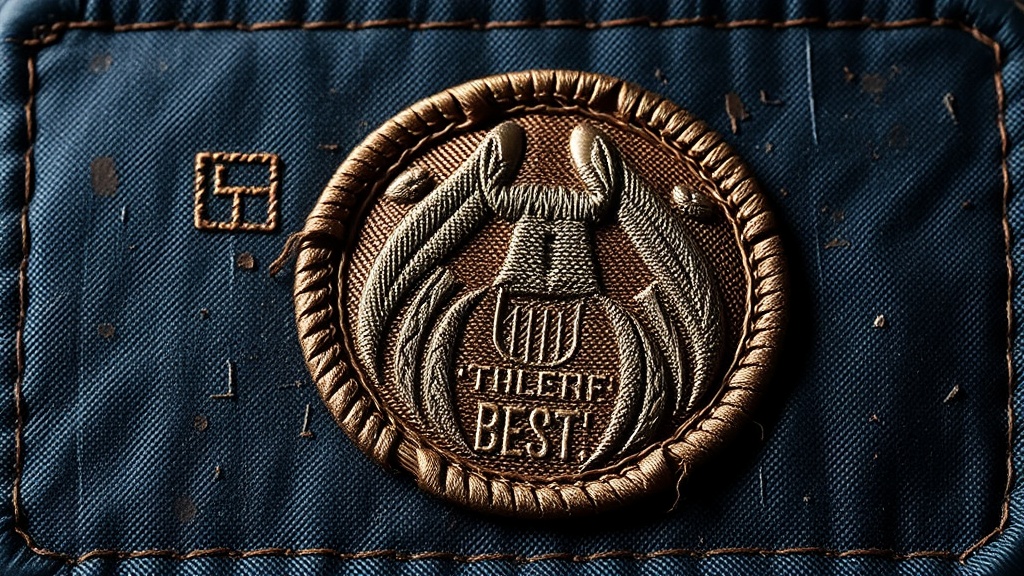
What Your Patch Backing Reveals About Its Real Age

Most collectors judge a military patch by what they can see—the embroidery quality, the colors, the unit designation stitched across the front. That's backward. The real story of any patch hides on its reverse side, in the backing material, the edge finish, and the construction method used during manufacture. Understanding these physical characteristics doesn't just help you date a piece accurately; it protects you from sellers who misrepresent modern reproductions as vintage originals. This guide breaks down exactly what to look for when you flip a patch over—and why those details matter more than the design facing outward.
Why Do Cut-Edge and Merrowed Borders Matter for Dating?
The edge finish on a military patch tells you immediately whether you're looking at something from the World War II era or a modern production run. Cut-edge patches—where the fabric is simply cut to shape and the embroidery holds the threads together—dominated military production from the 1940s through the 1960s. These patches feel rougher, show fraying at the edges over time, and were cheaper to manufacture in massive quantities for rapidly mobilizing forces.
Merrowed edges—that distinctive overlocked stitching around the perimeter—became standard later, particularly as manufacturing equipment improved and the military prioritized durability. Vietnam-era patches increasingly show this finish, and by the 1980s it became the norm for most official issue items.
Here's where collectors get tripped up. Many reproduction makers deliberately use cut-edge construction because they know buyers associate it with "old." A modern patch with a cut edge isn't automatically vintage—it's just using an older construction method. You need to combine edge analysis with backing examination to get the full picture. (And don't get me started on sellers who trim merrowed edges to fake the cut-edge look—yes, that's a thing, and yes, it's detectable under magnification.)
The National WWII Museum maintains excellent reference materials on wartime production methods that help collectors understand these manufacturing transitions. Their archives document how the military shifted from embroidered designs to printed patches during material shortages—another clue that surface embroidery alone doesn't tell the whole story.
What Backing Materials Indicate About Production Era?
Flip any patch over and you'll find one of several backing types—each carrying specific historical significance. Paper backing appeared extensively during World War II when manufacturers needed cheap, disposable materials that wouldn't add weight to uniforms. These backings often carried printed manufacturer information, contract numbers, or QM (Quartermaster) stamps that help authenticate period pieces.
Cloth backings—typically cotton or canvas—served dual purposes. They provided structural integrity to the embroidery and allowed soldiers to sew patches directly onto uniforms without additional reinforcement. You'll find these on many Korean War and early Vietnam-era pieces. The cloth quality itself offers dating clues; wartime production used specific weaves and weights that differ from modern reproduction attempts.
Plastic and vinyl backings emerged in the 1960s and 1970s as synthetic materials became cheaper and more durable. These backings offer excellent preservation—the plastic shields the embroidery from moisture and prevents the fraying common in older cloth-backed pieces. However, plastic backings also present authentication challenges because modern manufacturers can easily replicate the look while using contemporary materials.
The Smithsonian Institution's collection of military textiles includes extensive documentation of how backing materials evolved alongside broader manufacturing trends. Their research shows that backing transitions rarely happened overnight—there were always overlap periods where multiple types circulated simultaneously.
Can You Spot Reproductions by Construction Alone?
Construction analysis won't definitively prove authenticity—nothing replaces provenance research and documentation—but it will quickly eliminate obvious fakes. Modern reproduction patches often betray themselves through construction inconsistencies that wouldn't occur in period manufacturing.
Thread type offers one clear signal. Vintage military patches used specific cotton or rayon threads that age distinctly—cotton develops a soft patina while rayon maintains a slight sheen but becomes brittle. Modern polyester threads stay too crisp, too bright, and resist the natural aging patterns you'd expect from decades-old pieces.
Embroidery density presents another tell. Wartime manufacturing prioritized speed and volume; embroidery tended toward simpler designs with fewer stitches per inch. Modern reproductions often over-embroider—adding detail and density that looks "better" but contradicts authentic production methods. If a supposedly 1940s patch looks like it was made with modern computer-controlled embroidery machines, that's exactly what probably happened.
Backing attachment methods also reveal tampering. Original paper backings were glued using specific adhesives that deteriorate predictably over time. Fresh glue, modern synthetic adhesives, or paper that looks too clean for its claimed age all signal potential problems. Similarly, original cloth backings were sewn with specific stitch patterns—straight lockstitch for most US production, different patterns for British and Commonwealth pieces.
The Library of Congress Veterans History Project contains oral histories and documentation from textile workers who manufactured military insignia during various conflicts. These firsthand accounts describe the production pressures, material constraints, and quality standards that shaped authentic patch construction—details reproduction makers rarely get right.
Common Backing Combinations by Era
Certain backing and edge combinations appear reliably in specific periods:
- World War II: Paper or thin cloth backing, cut edges, simple chainstitch or lockstitch embroidery
- Korean War: Cloth backing predominates, mixed cut-edge and early merrowed construction
- Vietnam era: Transition to plastic/vinyl backings, merrowed edges becoming standard
- Post-1980: Heavy plastic backings, uniform merrowed edges, synthetic thread dominance
These aren't absolute rules—manufacturing variation existed, and theater-made patches often broke every guideline. But they provide useful baseline expectations when examining unknown pieces.
Why Theater-Made Patches Break All the Rules
Everything above assumes factory production—which theater-made patches ignore completely. When units couldn't get official insignia through regular supply channels, they improvised. Local tailors in Vietnam, Korea, and various European theaters produced patches using whatever materials were available. These pieces might have paper backings in 1968, cut edges when merrowed was standard, or embroidery density that matches no factory specification.
This irregularity makes theater-made patches both valuable and frustrating. Their construction often looks "wrong" by textbook standards, but that very wrongness proves authenticity. Collectors pay premiums for these pieces precisely because they represent genuine military history outside official channels.
The key difference between valuable theater-made pieces and worthless fakes comes down to evidence of period construction. Even improvised patches used period-appropriate materials—local Vietnamese tailors weren't working with modern polyester threads in 1967. The embroidery might be crude, the backing inconsistent, but the materials should still match the claimed era.
Documentation helps enormously here. Original photographs showing the patch in wear, unit records mentioning local procurement, or letters home describing the acquisition process all support authenticity claims that construction analysis alone cannot provide.
Handling and Storing Different Backing Types
Different backings require different preservation approaches. Paper-backed pieces need humidity control—too dry and the paper becomes brittle; too humid and mold becomes a risk. Cloth backings tolerate broader conditions but still suffer from light exposure and acidic storage materials. Plastic backings seem indestructible but can become sticky or discolored when stored against certain plastics or rubber materials.
Serious collectors maintain separate storage systems for each backing type rather than mixing everything in uniform albums or boxes. The few extra minutes this takes pays dividends in preservation over decades of ownership.
Construction analysis isn't glamorous work. It requires turning pieces over, examining edges under magnification, and learning the dull details of textile manufacturing history. But it's the difference between building a collection of genuine artifacts and accumulating expensive reproductions. The next time you examine a patch, spend twice as long on the back as you do admiring the front. That's where the real story hides.